
True Leadership Begins with Humility
Years ago, I read an article by Dr. Dwight A. Pryor, the Founder and President of the Center for Judaic-Christian Studies. In it, he compared…

Years ago, I read an article by Dr. Dwight A. Pryor, the Founder and President of the Center for Judaic-Christian Studies. In it, he compared two ancient locations: Herodium and Bethlehem. I’ve secured permission to reprint his article here. For leaders, it provides such a stark contrast that the lesson is clear: True leadership begins with humility.
The Humble Bethlehem
Author: Dwight A. Pryor
OF THE MONUMENTAL ARCHITECTURAL MASTERPIECES built by Herod the Great during his three-decade reign as King of Israel, none is more awe inspiring than the majestic palatial resort-fortress he constructed on the edge of the Judean wilderness and named after himself: Herodium.
Poised atop a man made mountain nearly twenty-five hundred feet high, Herodium afforded the King a panoramic view of his domain, including Jerusalem eight miles to the north. A ruthless ruler who gained power through political intrigue and marriage into the Hasmonean family, Herod was a master builder but a deeply troubled monarch. His rage and paranoia knew no bounds – even to the slaying of his own children and a beloved wife. His edifice complex was equally unchecked.
Herod’s most famous project was the extensive expansion of the Temple Mount in Jerusalem. In addition to the harbor at Caesarea and the “hanging palace” at Masada, he built multiple fortresses. But Herodium held an honored place in his heart. Not only was it a brilliantly designed fortress but the largest palatial complex in the Roman world at the time. Every conceivable luxury was incorporated into its design, including swimming pools, baths, gardens and a seven-hundred seat theatre.
It also was the place Herod chose to be buried. Only recently have archaeologists discovered the elaborate two-story domed mausoleum that served as his final resting place – midway up the northern face of Herodium. Even the ornate sarcophagus that once held the King’s remains was found among the shattered remnants of his distant kingdom.
NEARBY HERODIUM LAY A SMALL JEWISH VILLAGE named Beit Lechem (House of Bread in Hebrew). Only three miles away in distance, Bethlehem was a world removed from Herod’s opulence and grandeur. Populated by the lowest strata of Roman society, shepherds, and other common folks, no more than 200-300 people likely lived in the lowly rural community at the time.
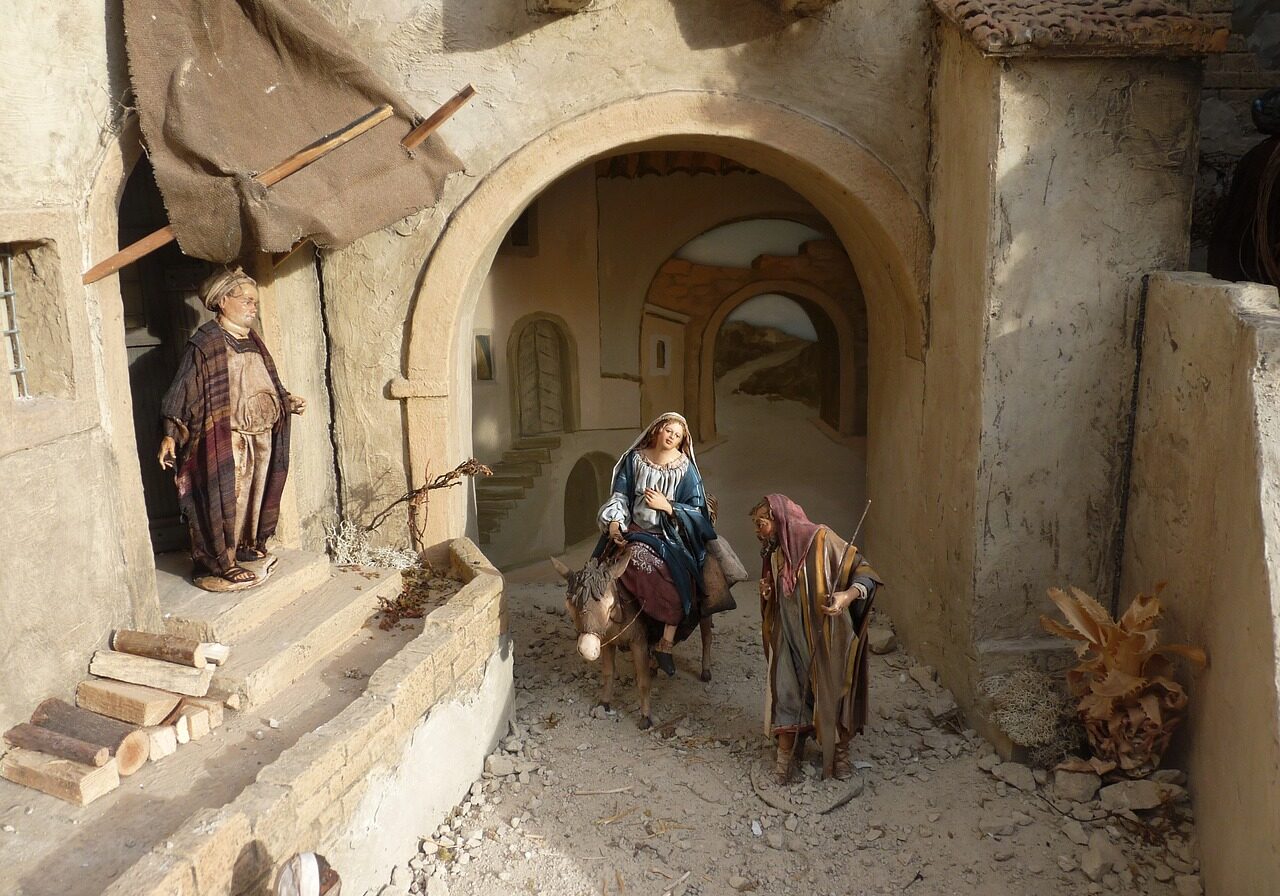
Herod died and was entombed at Herodium in 4 BC. Probably two years earlier, perhaps in the springtime when shepherds remained in the fields lambing their sheep, an uncommon child was born in Bethlehem to devout Jewish parents. They had taken refuge in a borrowed stable – likely a cave beneath a home, where the animals were kept – and placed their son in a feeding trough. Though he was truly of royal descent, his arrival was attended by livestock and shepherds. Not costly incense but the pungent smells of a stable would have filled the room.
Looking southeast from their primitive quarters, Jesus’ parents would have seen the monumental Herodium towering in the distance. What a contrast! One, a monument to self-exaltation; the other, a testament to the self-condescension of a loving God who, in accord with His word, sent His son to remedy the fractured human condition inherited from Adam.
Though Jesus was “the reflection of God’s glory and the exact imprint of His nature” (Heb 1:3), he did not aggrandize himself by his high-standing with God, but humbled himself and took on the role of a servant (Phil 2:8) – first to the Jewish people, “on behalf of God’s truthfulness, to confirm the promises given to the Patriarchs,” but also to the Gentiles, that they “might glorify God for his mercy” (Rom 15:8-9).
Herod designated himself, “the Great,” and lorded it over fearful people. Jesus declared, “I am gentle and humble in heart; learn of me and you will find rest for your souls” (Mt 11:29). Herod’s kingdom was built of might and power, and he raised up monuments to himself. Jesus proclaimed God’s kingship, propelled by the Holy Spirit, and he spent his life raising up many disciples.
Bethlehem’s child embodied fully the character of the God of Abraham – a God though high and exalted, “he hath respect for the lowly” (Ps 138:6 KJV). The Spirit of the true and living God, like water, always seeks out the low places. He is a “coming-down” God, passionate in pursuit of a people to bear His name and partner with Him in His redemptive agenda for the earth.
So when this God sent His Anointed One with good news for the humble (Isa 61:1), it was not to Herodium but to Bethlehem that he came. The contrast could not be sharper. In the words of the biographer Matthew: “Jesus was born in Bethlehem of Judea in the days of Herod the king…” (2:1).
© 2009 Dwight A. Pryor and The Center for Judaic-Christian Studies.
Not Sure Which You Need?
That's exactly what the first conversation is
Tell me what you're navigating. We'll figure out together whether you need a map, a mirror, or a bit of both — no pressure either way.
Keep Reading
More from the blog

Everyone Says Work on Your Business. Nobody Tells You How.
What does working on the business actually look like? What would you actually do? And just what might change in your company as a result?
Why Great Leaders Become Bottlenecks. And What to Do About It
“I’m the only one moving things forward.” I hear a version of this same sentence from leaders all the time. It usually surfaces after months of quiet frustration, right before they decide to fire a person or blow up a process. I always encourage them to pause and take a step back. Then I help…

The 7 Top Personal Issues for Leaders
Most leadership advice centers around business. Podcasts and books are filled with frameworks and strategies to run better meetings, build stronger org charts, and write better mission statements. Those are important challenges and a lot of the work I do is built around helping CEOs and teams wrestle through them. But the more I sit…