
A Different Take on the SWOT Analysis
Using this version of the SWOT Analysis will give you a different perspective on how to maximize opportunities for your company.

Most of us who have been in business for any length of time are familiar with the SWOT Analysis. Originated by Albert S. Humphrey in the 1960s, the SWOT is a useful tool for understanding a company’s Strengths and Weaknesses, and for identifying external Opportunities and Threats. This tool has been used to develop organizational strategy, marketing strategy and even personal growth plans.
Over the years, I’ve led many teams through this same tool. However, a few years ago, I was introduced to a different version of the SWOT by my colleagues at Five Capitals. Let me show you how this works.
What Is a SWOT Analysis?
As you know, in a traditional SWOT, we list out internal Strengths and Weaknesses. We also list out external Opportunities and Threats. Once those lists are completed, we then look for ways to leverage the Strengths and overcome Weaknesses. We also seek to capitalize on the Opportunities and avoid the Threats.
In the Five Capitals version, we take those lists and plot them along two axes of a matrix: a Strength-Weakness axis and an Opportunities-Threats axis. From there, we dig deeper to uncover the answers to four questions:
- Where are/can we see “Breakthrough”?
- Where are we experiencing “Battle”?
- Where are we experiencing “Frustration”?
- Where are we experiencing “Failure”
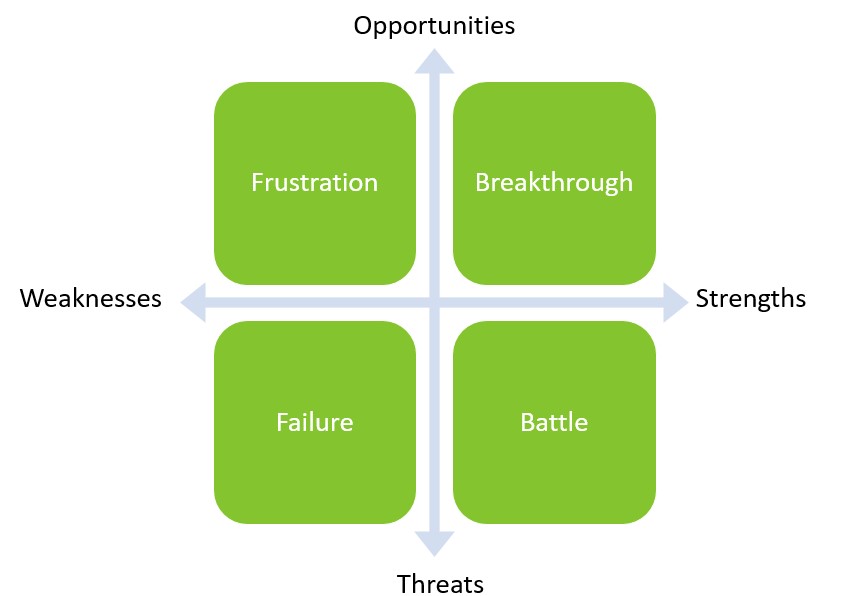
A Different Perspective on the SWOT Analysis Chart
Breakthrough = Strengths + Opportunities
Whenever we can leverage our Strengths to take advantage of an Opportunity, Breakthrough occurs. For example, an RFQ just came out (Opportunity), and our company is the only one that can meet the specification (Strength). In this quadrant, we do 2 things: we celebrate the Breakthrough we are currently experiencing, and we identify and strategize how we can achieve more Breakthrough.
Battle = Strengths + Threats
Whenever we can leverage our Strengths to avoid a threat, we find ourselves in a Battle. For example, our company has a patented technology that meets an RFQ requirement (Strength), but the competition is offering a lesser technology, claiming it meets the spec (Threat). In this quadrant, we strategize how to win the Battle.
Frustration = Opportunities + Weaknesses
Whenever we see an Opportunity, but our Weaknesses get in the way, that creates Frustration. For example, a customer calls to say they have a project, and they want to give it to your company (Opportunity). However, the project requires a service that you don’t offer directly, one you’ll have to outsource, which keeps you from being price competitive (Weakness). In this quadrant, we strategize by seeking to use Opportunities to overcome our Weaknesses, thus reducing the level of Frustration.
Failure = Weaknesses + Threats
Whenever our Weakness keeps us from avoiding a Threat, we experience Failure. For example, a major customer announces that all vendors are required to meet 95% on time delivery (Threat). Your company meets on-time delivery at 90% (Weakness). In this quadrant, we develop defensive strategies to mitigate the results of Failure.
Approaching the SWOT in this way provides a different perspective in developing organizational strategies. It allows you to wisely look at how best take advantage of opportunities and minimize the impact of outside threats.
Gain More Business Insights
Looking for new, innovative ways to leverage familiar business tools like the SWOT analysis? Contact me today to discuss business coaching opportunities.
Not Sure Which You Need?
That's exactly what the first conversation is
Tell me what you're navigating. We'll figure out together whether you need a map, a mirror, or a bit of both — no pressure either way.
Keep Reading
More from the blog

Everyone Says Work on Your Business. Nobody Tells You How.
What does working on the business actually look like? What would you actually do? And just what might change in your company as a result?

Why Great Leaders Become Bottlenecks. And What to Do About It
“I’m the only one moving things forward.” I hear a version of this same sentence from leaders all the time. It usually surfaces after months of quiet frustration, right before they decide to fire a person or blow up a process. I always encourage them to pause and take a step back. Then I help…

The 7 Top Personal Issues for Leaders
Most leadership advice centers around business. Podcasts and books are filled with frameworks and strategies to run better meetings, build stronger org charts, and write better mission statements. Those are important challenges and a lot of the work I do is built around helping CEOs and teams wrestle through them. But the more I sit…