
A Guide to Better Conversations
Unlock meaningful conversations with the Learning Circle framework. A shift from reactiveness to intentional communication can lead to conversation breakthroughs.

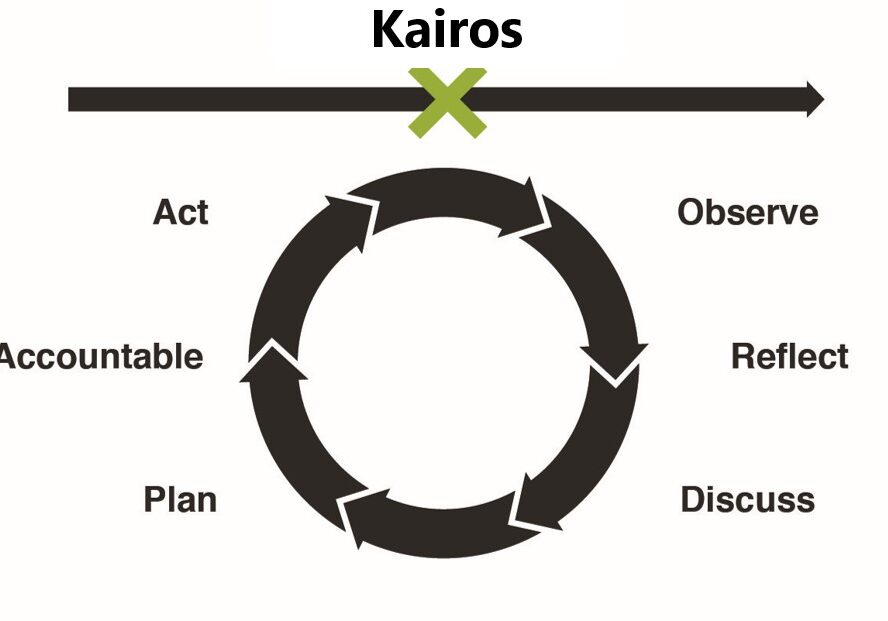
I find that so much of my coaching focuses on having the right conversations and helping my clients learn how to have effective conversations as well. Too often, core issues that need to be discussed get lost or pushed aside by other topics, or “rabbit trails” that don’t lead to resolution. To help them avoid these obstacles and stay on point, I guide them with tools and conversational frameworks that lead to breakthroughs. One of those tools is called the “Learning Circle”, an effective framework I learned from Five Capitals.
How to Have Better Conversations
The key to having a breakthrough conversation is to shift our stance from being reactive to being intentional. With conversations, intentionality starts by proactively looking for the “Kairos”. “Kairos” is a Greek word for time, as in “remember the time we went on vacation to Disney?” A “Kairos” is any event, whether great or small, that makes us stop for a moment. These are times for us to pause and see what we and those around us can learn. Once we identify the “Kairos”, we can then use the Learning Circle as our model for processing.
The Learning Circle Framework Steps
- Observe: Take an objective look at what’s going on. The main question here is
“What happened”? - Reflect: Seek to understand the reason, emotions, and other aspects of what happened. Here the main question is “Why did this happen?”
- Discuss: Use “voice-to-voice” (phone, video, or face-to-face; not email or text) conversation to Observe and Reflect. Together, process the “what” and the “why”.
At this point, we find ourselves at the bottom of the Learning Circle, gaining Awareness and clarity on the issue. We’re able to answer the question “What am I hearing or sensing? What’s the core issue?”
However, it doesn’t just matter what we know. What matters is what we do with what we know. We need to keep processing our conversation to lead to Action. We continue as follows…
- Plan: Here we move to respond to the clarity we’ve gained. We proactively answer, “What am I going to do, what’s the next right thing?”
- Account: Saying we’re going to do something is good. Committing to someone else that we’re going to do something is even better. Find people who will agree to keep you on task for what you said you’re going to do.
- Act: The time for talk is done. It’s now time to take action.
After we go through this conversational process, we find ourselves back at the top of the Learning Circle, ready to move past the “Kairos”. Now armed with a better understanding of what needs to be done, we continue on a different, more productive trajectory.
Ready to Develop Better Conversational Skills?
I offer effective tools and conversational frameworks that lead to breakthroughs like the Learning Circle. Reach out today to get started.
Not Sure Which You Need?
That's exactly what the first conversation is
Tell me what you're navigating. We'll figure out together whether you need a map, a mirror, or a bit of both — no pressure either way.
Keep Reading
More from the blog

The 7 Top Personal Issues for Leaders
Most leadership advice centers around business. Podcasts and books are filled with frameworks and strategies to run better meetings, build stronger org charts, and write better mission statements. Those are important challenges and a lot of the work I do is built around helping CEOs and teams wrestle through them. But the more I sit…

You Don’t Hate Planning. You Hate Planning Theater.
Let me start with a confession. I understand why so many leaders roll their eyes when someone says, “we need to do strategic planning.” Honestly, sometimes I do too. It’s not because planning is bad. It’s because many leaders have sat through planning processes that felt like an enormous waste of time. You know the…

The Answer Trap: Why the most capable leaders often become the biggest bottleneck
Leaders that become bottlenecks for their teams usually do so because they’re at leading.